
Open-Cell vs. Closed-Cell Spray Foam Insulation
Spray foam insulation is commonly divided into two main categories: open-cell spray foam and closed-cell spray foam. Both can help insulate and air seal a home or building, but they are not the same product.
The right choice depends on your project, budget, target R-value, moisture conditions, building type, and where the foam will be installed. A residential attic in Dallas-Fort Worth may call for a different approach than a metal building, commercial shop, garage, or wall assembly.
This guide explains the major differences between open-cell and closed-cell spray foam so you can better understand which option may be the better fit.
Which is better: open-cell or closed-cell spray foam?
Neither is automatically better for every project.
Open-cell spray foam is usually lighter, softer, more affordable, and often used in residential attics and interior cavities.
Closed-cell spray foam is denser, more rigid, more moisture-resistant, and provides a higher R-value per inch, but it usually costs more.
For many Dallas-Fort Worth homes, open-cell foam may be considered for attic rooflines and interior applications. For metal buildings, commercial spaces, limited-depth cavities, or moisture-sensitive areas, closed-cell foam may be the stronger option.
Side-by-Side Comparison
Open-Cell Spray Foam
Best known for: expansion, air sealing, sound reduction, and lower cost.
Typical R-value: about R-3.5 to R-3.9 per inch
Density: lower-density foam
Texture: softer and more flexible
Cost: generally less expensive than closed-cell foam
Moisture behavior: more vapor permeable
Common uses: residential attics, rooflines, interior walls, sound-control applications, large framing cavities
Main advantage: good air sealing at a lower cost
Main limitation: lower R-value per inch and less moisture resistance than closed-cell foam
Closed-Cell Spray Foam
Best known for: higher R-value, rigidity, moisture resistance, and durability.
Typical R-value: about R-6.0 to R-7.0 per inch
Density: higher-density foam
Texture: harder and more rigid
Cost: generally more expensive than open-cell foam
Moisture behavior: much less vapor permeable at sufficient thickness
Common uses: metal buildings, commercial spaces, exterior walls, rooflines, shops, garages, limited-depth cavities
Main advantage: higher R-value per inch and better moisture resistance
Main limitation: higher upfront cost
R-Value Comparison
R-value measures how well insulation resists heat flow. The higher the R-value, the more insulating power the material provides.
Open-cell spray foam usually provides about R-3.5 to R-3.9 per inch, while closed-cell spray foam commonly provides about R-6.0 to R-7.0 per inch. Actual R-values depend on the specific product, manufacturer specifications, installed thickness, and installation quality. Department of Energy guidance notes that insulation R-value depends on material type, thickness, and density, and that layers can be added together to estimate total R-value.
Example R-Value Estimates
Open-cell spray foam
3 inches: about R-10 to R-12
5 inches: about R-18 to R-20
8 inches: about R-28 to R-31
10 inches: about R-35 to R-39
Closed-cell spray foam
2 inches: about R-12 to R-14
3 inches: about R-18 to R-21
4 inches: about R-24 to R-28
5 inches: about R-30 to R-35
These are general planning ranges, not final design specifications. A contractor should confirm the exact foam product and target R-value before installation.
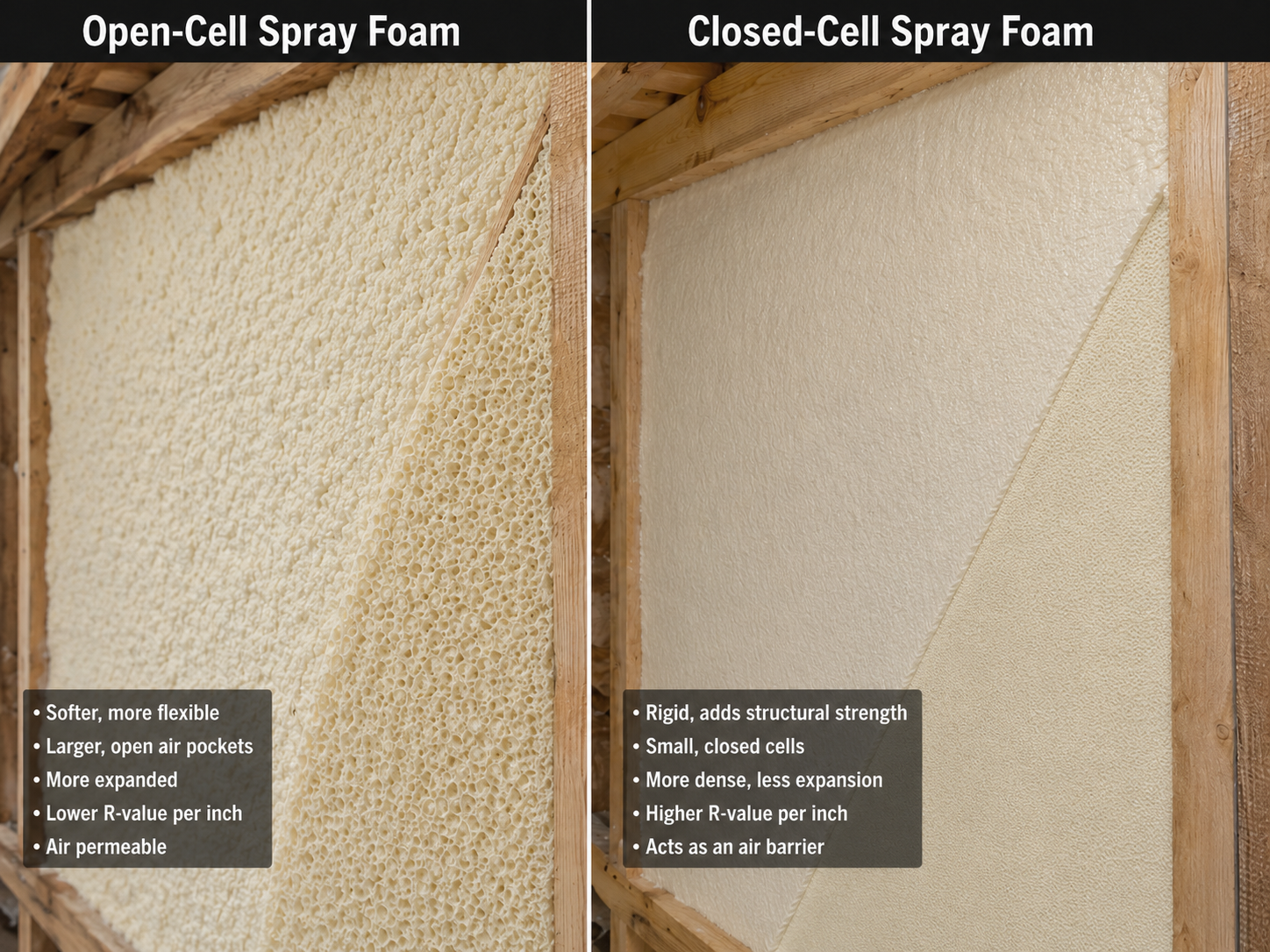
Open-Cell vs. Closed-Cell Spray Foam
Open-cell and closed-cell spray foam can both help insulate and air seal a building, but they perform differently. The right choice depends on the project, budget, target R-value, moisture conditions, and where the foam will be installed.
Open-Cell Spray Foam
Lighter, softer, more expanded, and often used in residential attic and interior applications.
Closed-Cell Spray Foam
Denser, harder, more rigid, and often used where higher R-value or moisture resistance matters.
Which Spray Foam Is Right for Your Project?
Open-cell foam is often a practical choice for residential attics and interior spaces where air sealing, sound reduction, and cost matter. Closed-cell foam is often preferred for metal buildings, commercial spaces, moisture-sensitive applications, and projects that need higher R-value in less space. The best choice depends on the building, moisture conditions, target R-value, budget, and installation location.
Cost Comparison
Open-cell spray foam usually costs less than closed-cell spray foam. The main reason is density. Closed-cell foam is denser, uses more material, and provides a higher R-value per inch.
Spray foam is often priced by the board foot. One board foot equals one square foot at one inch thick. So, if you spray 1,000 square feet at 3 inches thick, that is approximately 3,000 board feet.
General cost relationship
Open-cell spray foam: usually the lower-cost option
Closed-cell spray foam: usually the higher-cost option
Closed-cell foam can cost significantly more, but it may reduce the thickness needed to reach a target R-value.
Published national cost guidance varies widely. The Spruce reports an average spray foam insulation project cost around $5,500, with a broad range of about $2,400 to $8,600, depending on foam type, thickness, project area, and labor. Other contractor pricing guides commonly show open-cell foam priced lower per board foot than closed-cell foam.
Simple way to think about cost
Choose open-cell when you want spray foam benefits at a lower upfront cost and have enough space for the required thickness.
Choose closed-cell when you need higher R-value per inch, better moisture resistance, more rigidity, or performance in a metal building or commercial application.
Moisture Comparison
Moisture is one of the most important differences between open-cell and closed-cell foam.
Open-cell spray foam and moisture
Open-cell spray foam is more vapor permeable. That means water vapor can move through it more easily than closed-cell foam.
This can be good or bad depending on the assembly.
In some roofline applications, open-cell foam may allow a roof leak to become visible sooner because water can pass through the foam. However, open-cell foam is not usually considered a vapor barrier, and moisture control should be evaluated carefully.
Open-cell foam should not be used as a “moisture fix” for a roof leak, condensation problem, or poor ventilation design. Any moisture issue should be corrected before insulation is installed.
Closed-cell spray foam and moisture
Closed-cell spray foam is much less vapor permeable at sufficient thickness. It can resist water vapor movement better than open-cell foam and is often used where moisture resistance is important.
This is one reason closed-cell foam is commonly considered for:
Metal buildings
Exterior wall applications
Commercial buildings
Shops and warehouses
Certain roofline assemblies
Limited-depth cavities
However, closed-cell foam can also hide leaks or trap moisture if the building assembly is poorly designed. Building Science Corporation notes that closed-cell foam is sufficiently vapor impermeable to help control diffusion condensation, while open-cell foam may require additional vapor control in some environments.
Important moisture note
Neither open-cell nor closed-cell foam should be installed over active roof leaks, wet materials, moldy insulation, or unresolved moisture problems. The building should be evaluated first.
Air Sealing Comparison
Both open-cell and closed-cell spray foam can help reduce air leakage when installed properly.
Open-cell foam expands more and can fill large cavities well. Closed-cell foam expands less but is denser and can still create an effective air seal at proper thickness.
Building America guidance notes that spray foam used as an air barrier should meet appropriate thickness and continuity requirements; one PNNL guide gives example minimum thicknesses of 5.5 inches for open-cell and 1.5 inches for closed-cell in an exterior-wall air-barrier context.
The main point for homeowners is simple: both foams can air seal, but installation quality matters. Gaps, missed areas, poor adhesion, improper thickness, or rushed installation can reduce performance.
Lifespan Comparison
Both open-cell and closed-cell spray foam can be long-lasting insulation materials when installed correctly and protected according to product and code requirements.
Open-cell lifespan
Open-cell foam can last many years when installed in the right location, protected from bulk water, and used in a properly designed assembly.
It may be more vulnerable than closed-cell foam if exposed to water, roof leaks, or high-moisture conditions.
Closed-cell lifespan
Closed-cell foam is generally more durable and moisture-resistant. Because it is denser and more rigid, it is often preferred in harsher environments, metal buildings, and certain commercial applications.
Does one last longer?
Closed-cell foam is often viewed as the more durable product, but lifespan depends heavily on the building conditions. Poor installation, roof leaks, moisture problems, UV exposure, pests, fire/code issues, or improper application can shorten the life of either product.
A well-installed foam system in the right application can perform for decades, but the correct product and building design matter as much as the foam itself.
Best Uses for Open-Cell Spray Foam
Open-cell foam may be a good fit for:
Residential attic rooflines
Interior wall cavities
Sound-control applications
Large framing cavities
Homes where budget is a major factor
Projects where lower density and expansion are helpful
Attic applications where the assembly is properly designed
Open-cell foam is often chosen when the goal is to reduce air movement and improve comfort at a lower cost than closed-cell foam.
Best Uses for Closed-Cell Spray Foam
Closed-cell foam may be a good fit for:
Metal buildings
Commercial buildings
Shops and warehouses
Garages
Barndominiums
Exterior walls
Roofline applications needing higher R-value per inch
Limited-depth cavities
Areas where moisture resistance matters
High-performance insulation projects
Closed-cell foam is often chosen when the project requires higher R-value, greater rigidity, and better vapor resistance.
Which Foam Is Better for Attics in Fort Worth and surrounding areas?
For many DFW homeowners, the attic is the main concern because attics can become extremely hot during Texas summers.
Open-cell foam is often used along attic rooflines in residential applications because it expands well, air seals, and is usually more affordable than closed-cell foam.
Closed-cell foam may be considered when higher R-value per inch, moisture resistance, or a specific building-science requirement is important.
The right choice depends on:
Existing attic insulation
Roofline design
Ventilation strategy
HVAC equipment location
Ductwork location
Moisture conditions
Budget
Target R-value
Local code requirements
Roof condition
A local insulation provider should evaluate the attic before recommending either foam.
Which Foam Is Better for Metal Buildings?
Closed-cell foam is often the stronger choice for metal buildings because it provides higher R-value per inch, adds rigidity, and handles moisture concerns better than open-cell foam in many applications.
Metal buildings can experience condensation, temperature swings, radiant heat gain, and sound issues. Closed-cell spray foam may help address several of those concerns when installed properly.
Open-cell foam may still be used in some building types, but it is generally not the first choice where moisture resistance and metal surface performance are major concerns.
When Open-Cell May Be the Better Choice
Open-cell spray foam may be the better choice when:
Budget matters
The project is a residential attic
There is plenty of cavity depth
Sound reduction is a priority
The space is not moisture-sensitive
The assembly is designed to dry appropriately
The goal is air sealing at a lower cost
When Closed-Cell May Be the Better Choice
Closed-cell spray foam may be the better choice when:
Space is limited
Higher R-value per inch is needed
Moisture resistance is important
The project is a metal building
The project is commercial
The building needs added rigidity
The insulation is going on exterior walls or metal panels
The owner wants a premium, higher-density foam system
Common Mistakes to Avoid
Open-cell is usually cheaper, but that does not automatically make it the better value. Closed-cell may cost more but may perform better in certain applications.
Closed-cell has a higher R-value per inch, but open-cell may still be a practical choice when there is enough space and moisture conditions are appropriate.
Spray foam should not be used to cover up leaks, mold, wet insulation, or unresolved moisture problems.
Spray foaming a roofline can change how the attic behaves. Ventilation, moisture control, combustion safety, ductwork, and HVAC performance should be considered.
Assuming all spray foam contractors are equal
Installation quality matters. Foam should be applied at the proper thickness, ratio, temperature, and surface condition. Poor installation can cause odor, adhesion problems, gaps, or underperformance.
Quick Decision Guide
Consider open-cell spray foam if you want:
A lower-cost spray foam option
Good air sealing
A residential attic solution
Sound reduction
A softer, more flexible material
Foam that expands into large cavities
Consider closed-cell spray foam if you want:
Higher R-value per inch
Better moisture resistance
A denser and more rigid material
A metal building insulation option
A commercial insulation option
Performance in limited-depth spaces
A premium spray foam system
Frequently Asked Questions
Is closed-cell spray foam always better than open-cell?
No. Closed-cell foam has a higher R-value per inch and better moisture resistance, but it also costs more. Open-cell foam may be a better choice for many residential attic applications where cost, expansion, and air sealing are priorities.
Is open-cell spray foam bad?
No. Open-cell spray foam can be a strong insulation option when installed in the right location and assembly. It is commonly used in residential attics and interior applications.
Can open-cell spray foam absorb water?
Open-cell foam is more vapor permeable and can allow moisture to move through it more easily than closed-cell foam. It should not be installed where bulk water, roof leaks, or chronic moisture problems exist.
Is closed-cell spray foam waterproof?
Closed-cell foam is much more moisture-resistant than open-cell foam, but it should not be treated as a substitute for proper waterproofing, roof repair, or moisture management.
Which has the better R-value?
Closed-cell spray foam has the higher R-value per inch, typically about R-6.0 to R-7.0 per inch. Open-cell spray foam is typically about R-3.5 to R-3.9 per inch.
Which costs more?
Closed-cell spray foam usually costs more than open-cell foam because it is denser and uses more material.
Which lasts longer?
Both can last many years when installed correctly. Closed-cell foam is generally more durable and moisture-resistant, but either product can underperform if installed poorly or exposed to the wrong conditions.
Which is better for sound control?
Open-cell foam is often used for sound-control applications because of its softer, more open structure. However, true soundproofing depends on the whole wall, ceiling, or floor assembly.
Request a Spray Foam Insulation Quote
Open-cell and closed-cell spray foam can both be strong insulation options, but they are designed for different applications. The best choice depends on your home or building, target R-value, moisture conditions, budget, and performance goals.
Let us help you decide if a particular spray foam is the right choice for you, or if it would be better to consider other options like blown-in insulation.