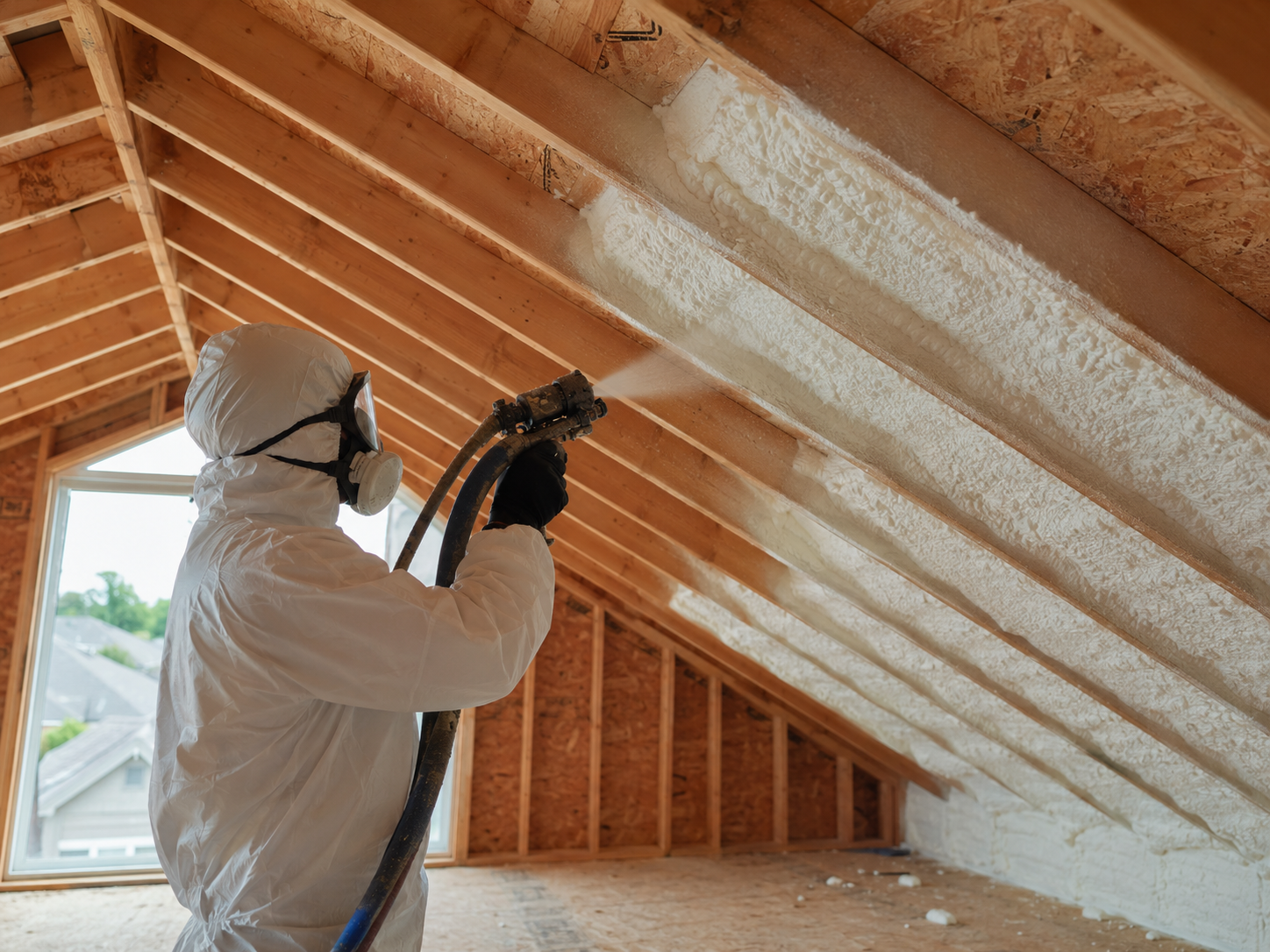
Spray Foam Insulation in Dallas-Fort Worth
Spray foam insulation is one of the most talked-about insulation options for homes, attics, shops, garages, metal buildings, and commercial spaces. When installed properly, spray foam can help reduce air movement, improve comfort, and create a tighter building envelope.
For property owners in Dallas-Fort Worth, spray foam insulation is often considered for hot attics, uncomfortable rooms, new construction, barndominiums, metal buildings, workshops, commercial buildings, and homes where energy efficiency and comfort are a priority.
DFW Insulation Contractors helps homeowners and property owners compare local spray foam insulation options throughout Dallas, Fort Worth, Grapevine, Southlake, Colleyville, Flower Mound, Keller, Mansfield, Plano, Frisco, McKinney, Arlington, Irving, Grand Prairie, and surrounding North Texas communities.
If you are considering spray foam insulation, it is important to understand how it works, where it performs well, what the R-values mean, and when another insulation option may be a better fit.
What Is Spray Foam Insulation?
Spray foam insulation is a spray-applied insulation material that expands after application. It is commonly used to insulate and air seal attics, walls, rooflines, crawl spaces, shops, garages, and commercial buildings.
Unlike loose-fill or batt insulation, spray foam can expand into cracks, gaps, and irregular spaces. This is one reason it is often discussed as both an insulation product and an air-sealing product.
Spray foam is typically installed by trained professionals using specialized equipment. Once applied, the foam expands, cures, and forms an insulating layer over the surface.
Spray foam is commonly used in:
Residential attics
Rooflines
Exterior walls
New construction
Remodeling projects
Metal buildings
Barndominiums
Shops and workshops
Detached garages
Commercial spaces
Warehouses
Agricultural buildings
Sound-control applications
Spray foam can be a strong option, but it is not automatically the best choice for every home or building. The right system depends on the structure, budget, moisture conditions, ventilation strategy, HVAC setup, and performance goals.
Open-Cell vs. Closed-Cell Spray Foam
The two most common types of spray foam insulation are open-cell spray foam and closed-cell spray foam. Both can be useful, but they perform differently.
Open-Cell Spray Foam
Open-cell spray foam is lighter, softer, and less dense than closed-cell foam. It expands significantly after application and can fill open cavities well.
Open-cell foam is commonly used in:
Attic rooflines
Interior wall cavities
Sound-reduction applications
Residential insulation projects
Large open framing cavities
Open-cell spray foam generally provides about R-3.5 to R-3.9 per inch, depending on the specific product. It can help reduce air movement and may be a good option when the goal is to create a more comfortable and better-sealed attic or wall assembly.
Open-cell foam is typically less expensive than closed-cell foam, but it does not provide the same R-value per inch and is more vapor permeable. That means moisture and building design should be considered carefully.
Closed-Cell Spray Foam
Closed-cell spray foam is denser, harder, and more rigid than open-cell foam. It has a higher R-value per inch and can add some structural rigidity to certain building assemblies.
Closed-cell spray foam is commonly used in:
Metal buildings
Commercial spaces
Exterior walls
Areas with limited cavity depth
Moisture-sensitive applications
Shops and warehouses
New construction
High-performance insulation projects
Closed-cell spray foam generally provides about R-6.0 to R-7.0 per inch, depending on the product. Because it offers more R-value per inch, closed-cell foam can be useful where space is limited or higher insulation performance is needed in a thinner layer.
Closed-cell foam usually costs more than open-cell foam, but it may be preferred for certain commercial, metal building, or high-performance applications.
Typical Spray Foam R-Values
R-value measures how well insulation resists heat flow. The higher the R-value, the greater the insulating power.
Spray foam is often compared by its R-value per inch:
Open-cell spray foam: typically about R-3.5 to R-3.9 per inch
Closed-cell spray foam: typically about R-6.0 to R-7.0 per inch
For example:
3 inches of open-cell spray foam may provide roughly R-10 to R-12
5 inches of open-cell spray foam may provide roughly R-18 to R-20
8 inches of open-cell spray foam may provide roughly R-28 to R-31
2 inches of closed-cell spray foam may provide roughly R-12 to R-14
3 inches of closed-cell spray foam may provide roughly R-18 to R-21
5 inches of closed-cell spray foam may provide roughly R-30 to R-35
These are general planning ranges only. Actual R-values depend on the specific product, thickness, density, installation quality, and manufacturer specifications.
R-value is important, but it is not the only factor. Spray foam’s ability to reduce air movement is one reason it may perform differently than traditional insulation systems with similar nominal R-values.
Why Air Sealing Matters
One of the biggest advantages of spray foam insulation is its ability to help reduce air leakage.
Traditional insulation materials can slow heat transfer, but they may not stop air movement unless paired with proper air sealing. Spray foam can help seal gaps, cracks, and cavities as it expands, which may improve comfort and reduce unwanted air movement.
Air leakage can affect:
Hot and cold rooms
Dust movement
Humidity control
HVAC performance
Comfort near ceilings and exterior walls
Temperature consistency
Attic-to-living-space heat transfer
In North Texas, air sealing can be especially important because attics can become extremely hot during the summer. If hot attic air is able to move into the living space, the home may feel less comfortable and the HVAC system may have to work harder.
That said, a tighter home or attic assembly needs to be planned correctly. Ventilation, combustion safety, indoor air quality, moisture control, and HVAC design should all be considered.
Spray Foam Insulation for Attics
Attic spray foam insulation is one of the most common spray foam applications in Dallas-Fort Worth. Many homeowners consider spray foam because they have hot upstairs rooms, high cooling bills, old attic insulation, or HVAC ducts located in a very hot attic.
Spray foam can be installed in different attic configurations depending on the project.
Roofline Spray Foam
In some homes, spray foam is applied to the underside of the roof deck. This can bring the attic closer to the conditioned space and may help reduce attic temperature extremes.
This type of system can be helpful when HVAC equipment or ductwork is located in the attic. However, it also changes how the attic behaves, so ventilation, moisture, code requirements, and HVAC design should be evaluated by a qualified professional.
Attic Floor Insulation
In other homes, insulation is installed along the attic floor to separate the conditioned living space from the unconditioned attic. Spray foam may be used in certain attic floor or air-sealing applications, but blown-in insulation is often used for attic floor upgrades.
The right approach depends on the home’s design, existing insulation, roof structure, ventilation, and budget.
Spray Foam for Metal Buildings, Shops, and Barndominiums
Spray foam insulation is often used in metal buildings, workshops, garages, and barndominiums because these structures can be difficult to keep comfortable without proper insulation.
Metal buildings can experience heat gain, condensation concerns, temperature swings, and sound issues. Closed-cell spray foam is often considered for metal buildings because it can provide higher R-value per inch and help reduce air movement.
Common applications include:
Metal shops
Detached garages
Barndominiums
Warehouses
Agricultural buildings
Storage buildings
Commercial buildings
Workshops
Insulated roof and wall assemblies
The right foam type and thickness depend on how the building will be used. A storage building may need a different insulation approach than a finished shop, climate-controlled workspace, or occupied barndominium.
Benefits of Spray Foam Insulation
Spray foam insulation may offer several benefits when properly installed.
Spray foam can help reduce unwanted air movement and heat transfer, which may make rooms feel more consistent and comfortable.
Spray foam can expand into gaps and cracks, helping create a tighter building envelope.
Closed-cell spray foam provides a higher R-value per inch than many common insulation materials, which can be helpful in areas with limited space.
Because it is spray-applied, foam can fit around framing, cavities, rooflines, and irregular spaces where batt insulation may be difficult to install well.\
In certain attic designs, spray foam can help reduce temperature extremes around HVAC equipment and ductwork.
Open-cell spray foam may help reduce sound transmission in some interior applications, depending on the assembly.
Spray foam can be used in homes, shops, warehouses, offices, metal buildings, and other property types.
Limitations of Spray Foam Insulation
Spray foam is a strong insulation option, but it is not perfect for every project. A trustworthy insulation contractor should explain both the benefits and the limitations.
Spray foam usually costs more than fiberglass or blown-in insulation. Closed-cell foam is generally more expensive than open-cell foam.
Spray foam should be installed by trained professionals using proper equipment, product ratios, safety procedures, and application methods.
Spray foam can change how an attic or wall assembly handles air and moisture. The wrong approach can create problems if ventilation, roof conditions, humidity, or building design are not considered.
Roof leaks, moisture problems, pest contamination, damaged insulation, and air-quality concerns should be addressed before spray foam is installed
Some homes may be better served by air sealing plus blown-in insulation, radiant barrier, duct sealing, or a different attic upgrade strategy
Old insulation may need to be removed before spray foam is applied, especially if the attic is contaminated, damaged, or preventing proper installation.
Some spray foam applications may require ignition barriers, thermal barriers, or other code-related protections. These requirements depend on the location, building type, foam product, and local code interpretation.
Spray Foam vs. Fiberglass Insulation
Spray foam and fiberglass insulation are often compared, but they work differently.
Fiberglass is a traditional insulation material used in batts or blown-in form. It can be cost-effective and widely available, especially for attic insulation upgrades.
Spray foam generally costs more, but it can help reduce air movement and may provide better performance in certain applications.
Spray Foam May Be Better When:
Air sealing is a major goal
The attic has HVAC ducts or equipment
The building is a metal shop or barndominium
Higher performance is desired
The structure has irregular cavities
The project involves new construction
There is limited space for insulation thickness
Fiberglass or Blown-In Insulation May Be Better When:
Budget is the main priority
The attic floor needs additional insulation
The existing insulation is in decent condition
The home needs a practical retrofit upgrade
Spray foam is not appropriate for the attic design
The best solution may also combine strategies. For example, a home might benefit from air sealing plus blown-in insulation rather than spray foam throughout the attic.
Spray Foam vs. Radiant Barrier
Spray foam insulation and radiant barrier are not the same thing.
Spray foam resists heat flow and can help reduce air movement. It is rated by R-value. While radiant barrier is a reflective material designed to reduce radiant heat transfer. It is not usually rated like traditional insulation and generally requires an air space to work properly. In DFW, both products are often considered for attic heat reduction, but they solve different problems. Spray foam may be used to create a tighter, more insulated attic or building envelope. Radiant barrier may be used to reduce radiant heat gain from the roof deck into the attic space.
The right choice depends on the home, attic design, existing insulation, roofline, ventilation, and budget.
How Much Does Spray Foam Insulation Cost?
Spray foam insulation cost depends on several factors. It is usually priced based on the area being sprayed, foam type, foam thickness, access, prep work, and project complexity.
Factors that affect spray foam cost include:
Open-cell vs. closed-cell foam
Total square footage
Thickness required
Target R-value
Attic, wall, roofline, or metal building application
Existing insulation removal
Moisture or pest contamination
Access difficulty
New construction vs. retrofit
Residential vs. commercial project
Ignition or thermal barrier requirements
Closed-cell foam generally costs more than open-cell foam because it is denser and provides a higher R-value per inch.
The best way to understand pricing is to request a quote based on your specific project.